How Does a Room Thermostat Work? What It Controls and What It Does Not
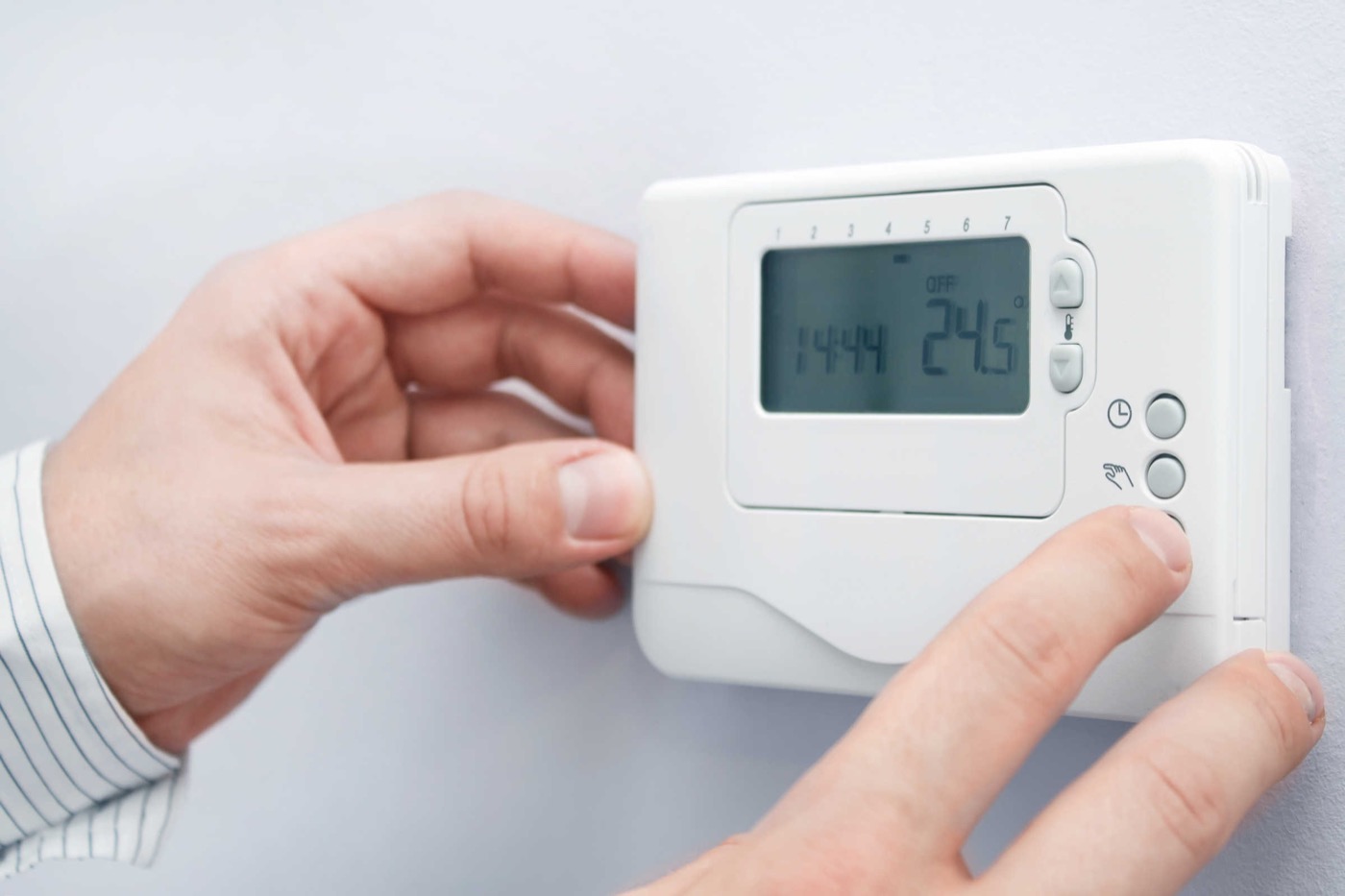
A room thermostat is a temperature-controlled switch. It measures the air in one room and tells the boiler to stop heating once that room reaches the temperature you set, then calls for heat again when it cools. It does not control how hot the radiators get or how fast the house warms.
A room thermostat works as a switch controlled by temperature. It measures the air in the room where it is fitted, calls for heat while that room is below the temperature you set, and tells the boiler to stop once it gets there. It controls when the heating stops, not how fast it runs or how hot the radiators get.
What a Room Thermostat Actually Does
A room thermostat turns the demand for heat on and off. It does not heat anything and it does not set the radiator temperature; it simply tells the boiler, and on some systems a zone valve, whether heat is still wanted. For how the boiler, pump, valves and radiators fit together around it, see how central heating works.
On a typical system the thermostat sits in a loop of wiring with the programmer or timer. The timer decides when the heating is allowed to run, and the thermostat decides whether it needs to run within that window. When the room is cold, the thermostat closes its contact and the boiler fires and the pump runs. When the room reaches the set temperature, the contact opens and the boiler stops heating the radiators. On systems with a hot water cylinder, a separate cylinder thermostat does the same job for the stored hot water.
How the Thermostat Senses Temperature
Older dial thermostats use a mechanical element that moves as it warms and cools, while digital and smart thermostats use an electronic sensor. Both measure the air around the thermostat itself, not the room as a whole.
In a traditional dial thermostat the sensing element bends or expands with temperature and physically opens or closes a switch. These are simple and long-lived but not very precise, and they drift over many years. Digital thermostats use a small electronic sensor and a relay, which gives more accurate readings and allows scheduling on the same unit. Smart thermostats add a connection to the internet so they can be controlled from a phone.
All of them have a small switching band, often called the differential. The heating goes off at or just above the set point and comes back on once the room drops slightly below it. Without that band the boiler would switch on and off every few seconds. Many digital thermostats also start the heating a little early or ease it off as the room approaches the set point, to avoid overshooting.
Does Turning the Thermostat Up Heat the House Faster?
No. Turning a room thermostat up to 30 degrees does not make the radiators hotter or the house warm faster. It only moves the point at which the heating switches off, so the house keeps heating past the temperature you actually wanted.
With a basic on/off thermostat, the boiler heats the radiators to the flow temperature set on the boiler, whatever the thermostat dial says. The house warms at the same rate either way. The only difference is that a high setting lets it overshoot and waste energy, and the room becomes uncomfortably hot before anyone turns it back down.
There is one partial exception. Some modern thermostats talk to the boiler using a communication protocol such as OpenTherm rather than a simple on/off signal, and ask the boiler for lower or higher flow temperatures depending on how far the room is from its target. Even then, cranking the setting up is not the right way to warm the house faster; setting a sensible temperature and letting the controls do the work is. If your house genuinely takes too long to warm, our guide to why heating takes so long to warm up covers the usual causes.
Where a Room Thermostat Should Be Fitted
A room thermostat should be in a room that represents the house, usually a hallway or main living room, at around shoulder height on an inside wall. It must be clear of radiators, direct sunlight, draughts and heat from cooking or electronics.
Because the thermostat only knows the temperature of the air around it, a badly placed one gives the whole house the wrong instruction. Common problems we see in London homes include:
- a thermostat in a sunny front room that switches the heating off on bright winter afternoons while the back of the house is cold
- one fitted above a radiator or next to a television, which reads warm and cuts the heating early
- one in a draughty hallway by the front door, which reads cold and keeps the boiler running
- one in a kitchen, where the oven warms the air and leaves the rest of the house underheated
- a thermostat in a room with a TRV on its radiator, where the two controls fight each other
The radiator in the room with the thermostat is normally left without a TRV, or with its TRV set fully open. If the TRV shuts that radiator down first, the thermostat never reaches its set point and the boiler keeps heating the rest of the house.
Room Thermostat, TRVs and Smart Controls: How They Fit Together
A room thermostat decides whether the house as a whole needs heat; thermostatic radiator valves decide how much heat each room takes while the heating is on. You need both, because neither can do the other one's job.
With only a room thermostat, every room follows the one where the thermostat sits. With only TRVs and no thermostat, the boiler keeps running even when every room is warm, because nothing tells it to stop. That is why the minimum set of controls for a wet system includes a timer, a room thermostat, TRVs on most radiators and wiring that switches the boiler off when nothing needs heat. Our guide to what heating controls a house needs sets out the full list.
A smart thermostat replaces the timer and the room thermostat in one device, and adds scheduling and remote control. Smart radiator heads go further and give each room its own schedule. Neither changes how the underlying thermostat logic works: something still has to measure a temperature and switch the boiler.
When the Thermostat Is Not the Problem
If the thermostat is calling for heat but the house stays cold, the fault is usually elsewhere in the system. A faulty thermostat is possible, but unbalanced radiators, sludge, a stuck zone valve or undersized radiators are more common.
A quick check is whether the boiler responds when you turn the thermostat up a few degrees. If it fires and the pump runs, the thermostat is doing its job and the heat is not reaching the rooms. That points to a system issue such as radiators that need balancing, a zone valve that is not opening, or sludge restricting flow. If nothing responds at all, check the timer is in an on period and the thermostat has power or fresh batteries. Anything inside the boiler itself is a job for a Gas Safe registered engineer.
Replacing a working thermostat with a newer one will not fix a system that cannot deliver heat, so it is worth finding the real cause before buying new controls.
Thinking about new heating controls? We check where your thermostat is, how it is wired and whether the rest of the system can deliver the heat, then recommend the controls that suit your home. See our smart heating controls service or book a survey.
Frequently asked questions
What temperature should a room thermostat be set to?
Most homes are comfortable with the room thermostat set somewhere around 18 to 21 degrees. The right setting is the lowest one at which the household is comfortable. Each degree higher means the heating runs longer, so it is worth turning it down gradually and seeing whether anyone notices.
Is it better to leave the thermostat on constantly or use a timer?
For most homes with a gas boiler and radiators, heating only when needed with a timer uses less energy than holding the house at temperature all day. Well-insulated homes and heat pumps behave differently and can suit longer, lower-temperature running. The room thermostat still decides when to stop in either case.
Can a room thermostat be moved to a different room?
Yes. A wired thermostat can be moved by running new cable, and many wireless thermostats can simply be relocated and re-paired with their receiver. Moving a thermostat out of a sunny room, kitchen or draughty hall often improves comfort across the whole house without changing anything else.