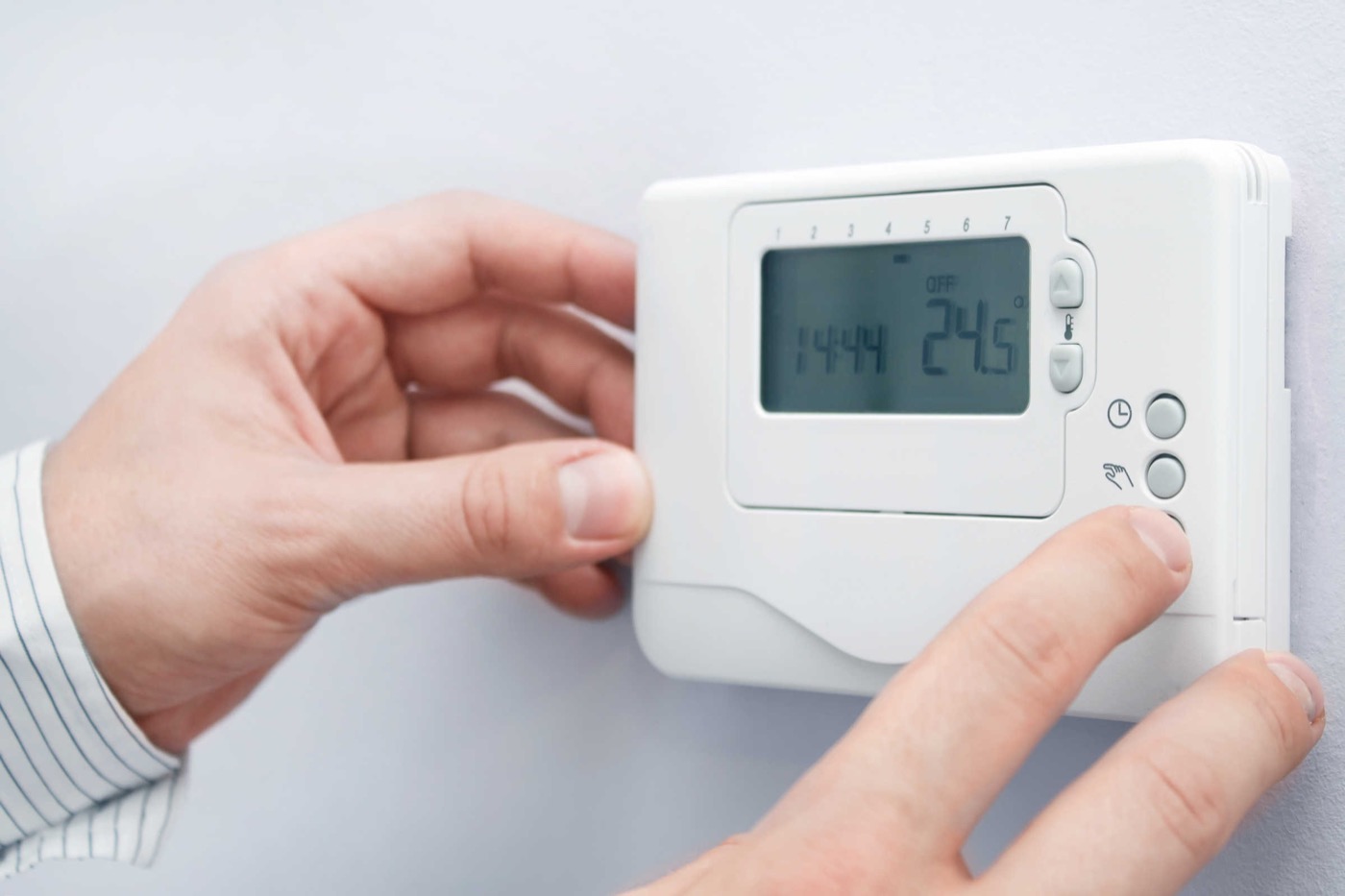
A house with a boiler and radiators needs four basic controls: a timer or programmer, a room thermostat, TRVs on most radiators and a boiler interlock. Homes with a hot water cylinder also need a cylinder thermostat and separate hot water timing.
A house with a boiler and radiators needs four basic heating controls: a timer or programmer to set when the heating runs, a room thermostat to set how warm the house gets, thermostatic radiator valves (TRVs) on most radiators to control each room, and a boiler interlock so the boiler switches off when nothing needs heat. If you have a hot water cylinder, add a cylinder thermostat and separate timing for hot water. A smart thermostat can replace the timer and room thermostat in one device, but it does not replace the rest.
The Four Controls Every Wet Heating System Should Have
Each control does a different job, and a system missing one of them wastes energy in a way the others cannot make up for. Here is what each one does.
Timer or programmer
This sets when the heating is allowed to come on. A basic timer has one or two on periods a day; a programmer lets you set different times for weekdays and weekends, and on systems with a cylinder, separate times for heating and hot water.
Room thermostat
This measures the air temperature in one room and switches the heating off when the house is warm enough. It should be in a room that represents the house, usually a hallway or living room, away from radiators, direct sun, draughts and heat from cooking. Our guide to how a room thermostat works explains how it switches the boiler on and off.
Thermostatic radiator valves
TRVs control each radiator separately, so a sunny room or a bedroom kept cooler does not overheat while the thermostat room catches up. Our guide to how TRVs work explains the settings. The radiator in the room with the room thermostat is normally left without one.
Boiler interlock
This is not a device you buy but a way the controls are wired: when the room thermostat and, where fitted, the cylinder thermostat are both satisfied, the boiler is switched off. Without it, the boiler can keep firing and cycling to heat water that has nowhere useful to go. It is the control most often missing on older systems, and you cannot see it from the outside.
Extra Controls if You Have a Hot Water Cylinder
Homes with a system or regular boiler and a cylinder need two more things: a cylinder thermostat to stop heating the water once it is hot, and a way to heat the water independently of the radiators, usually one or two motorised zone valves.
The cylinder thermostat is usually strapped to the side of the cylinder about a third of the way up, and is commonly set somewhere around 60°C, which keeps water hot enough to control bacteria without wasting heat. Without one, the boiler keeps heating stored water for as long as the timer allows. Without separate zone control, you cannot have hot water in summer without the radiators coming on, or the reverse. Combi boilers heat water on demand and do not need either.
What the Building Regulations Expect
When a boiler is replaced or a new system is installed, Building Regulations guidance in England expects time control, room temperature control, room-by-room control such as TRVs where practical, and a boiler interlock. You are not required to upgrade controls on a system you are not otherwise changing.
Since 2018, anyone fitting a new combi boiler in England must also include at least one extra energy-saving measure from a set list. The options are weather compensation, load compensation, a smart thermostat with automation and optimisation, or flue gas heat recovery. Larger homes, generally those over 150 square metres of floor area, are expected to have at least two separately timed heating zones. The boiler installer is responsible for meeting these rules, and gas work must be done by a Gas Safe registered engineer.
Larger Homes Need Zoning
If parts of the house are used at different times, one thermostat and one timer for the whole house is a compromise. Zoning splits the system so each area has its own schedule and temperature.
Flats and small houses used on one pattern rarely need more than a single zone with TRVs. Larger houses, homes with a big extension or loft room, and households where someone works from home during the day are where zoning pays off.
The usual split is upstairs and downstairs, or the main house and an extension, using motorised zone valves with a thermostat and timer for each. Smart TRVs can go further and schedule individual rooms. Our smart heating controls guide compares the options and explains which suits which kind of house.
Signs Your Controls Need Upgrading
Your controls are due for attention if the heating runs on a fixed timer with no thermostat, if the thermostat sits in a room that is always warmer or colder than the rest, or if radiators have manual valves only.
Other signs:
- The boiler fires on and off even when the house is warm.
- You cannot have hot water without the heating coming on.
- An old mechanical programmer that loses its settings or does not match the clocks.
- Some rooms are always too hot while others never get warm. This can be a controls problem, but it is more often a balancing problem, which controls alone will not fix.
Upgrade the Controls or Replace the Boiler?
If the boiler is reliable, upgrading the controls is usually the cheaper and quicker way to cut waste and improve comfort. A new boiler with the same poor controls still wastes energy.
You do not need a new boiler to use a smart thermostat or smart TRVs; most work with existing boilers through a standard switched connection, and some modern boilers support a more precise modulating connection. What a controls upgrade cannot do is fix an unreliable boiler, a sludged system or radiators that are too small for their rooms. Our heating controls installation service covers thermostats, programmers, zone valves and TRVs, wired to work together. If you are not sure what you have, book a free survey and we will check what is missing before recommending anything.
Frequently asked questions
What is the minimum heating control a house should have?
A timer or programmer, a room thermostat, TRVs on most radiators and a boiler interlock so the boiler switches off when no heat is needed. Homes with a hot water cylinder also need a cylinder thermostat and separate hot water control.
Does a smart thermostat replace TRVs?
No. A standard smart thermostat replaces the timer and room thermostat, controlling the whole house from one room. TRVs, or smart TRVs, are still needed to control the temperature of individual rooms.
Where should a room thermostat be placed?
In a room that reflects the temperature of the house, often a hallway or living room, at about chest height on an internal wall. Keep it away from radiators, direct sunlight, draughts and kitchens, and do not fit a TRV on the radiator in the same room.