Underfloor Heating Losing Pressure? What to Check and When to Call
Wet underfloor heating that loses pressure is usually losing it at the manifold, an air vent or the expansion vessel, not under the floor. How to read the gauge, tell air from a leak, and know when to call.
Wet underfloor heating that keeps losing pressure is usually losing it at the manifold, at an air vent or through the expansion vessel, not from a pipe buried in the floor. Air working its way out of a new or recently altered system is the other common cause, and it is harmless. A leak in a buried loop is less common and the last thing to rule out. A week of simple gauge readings and a look at the manifold will usually tell you which one you have.
First, Work Out Whether Water Is Really Being Lost
A sealed heating system does not hold one fixed pressure. The water expands as it heats, so the gauge climbs while the heating runs and falls back as the system cools. Reading it once, at a random moment, tells you very little. Take it at the same two times each day for several days: first thing in the morning with the system cold, and again after the heating has been running for a while. Write the numbers down. Your boiler or manifold manual gives the correct cold fill pressure and the maximum for your equipment, so compare against those rather than a figure from the internet.
Then read the pattern:
- The cold reading dips a little, then settles after a top-up. That points to air leaving the water, not a leak.
- The cold reading falls by a similar amount every day, even after top-ups. Water is going somewhere.
- The hot reading climbs very high and the cold reading is low next morning. That is the signature of an expansion vessel that has lost its air charge.
- The reading creeps upwards after you top up. The filling loop may not be fully shut.
Air Is the Most Common and Least Worrying Cause
Fresh mains water carries dissolved air. When it is heated, the air comes out of solution and collects at high points and in the manifold. As it is vented, the pressure drops. This is normal in the first weeks after a system is filled, after a loop has been drained for repair work, or after a top-up. It tends to show as a small fall that stops once the air has gone and the automatic air vent has done its job.
The trouble starts when the same air stays trapped. A loop with air in it flows poorly, and the room it serves heats unevenly. Our guide to an airlock in a central heating system explains how air gets stuck and how it is cleared. If the pressure fall stops after a top-up and the floor heats normally, you are almost certainly looking at air.
The Expansion Vessel
The expansion vessel is a small tank with a rubber diaphragm and an air cushion. It soaks up the extra volume of water as the system heats, so the pressure does not spike. On a sealed system it usually sits inside the boiler casing or on the pipework nearby. Over the years its air charge can leak away.
When that happens, the water has nowhere to expand into. Pressure rises sharply on heating, and if it passes the pressure relief valve setting, a little water is discharged through the relief pipe, which normally ends outside. By the next morning the system has lost water and the gauge reads low. If you find a damp spot, drips or a stained wall at the end of that relief pipe, report it. Recharging or replacing a vessel inside a boiler is boiler work, and for gas appliances it must be done by a Gas Safe registered engineer.
The Filling Loop
The filling loop is the flexible hose or fixed valve set that lets mains water into the sealed system. It should be closed, and on many systems disconnected, once the system is filled. A valve that is not fully shut, or one that passes water slowly when closed, makes the pressure creep up after top-ups. Check that both valves are closed and that the hose is not weeping.
The Manifold: Where Most Slow Losses Happen
The manifold concentrates a lot of joints into one cupboard, so it is where small leaks most often start. With the heating running, put a dry piece of kitchen roll under each point in turn and look again after a few hours:
- Loop connections on the flow and return bars, where each pipe meets the manifold.
- Automatic air vents and their caps. A vent with a loose cap or a worn seat can weep or spit water.
- Drain-off points at the ends of the bars, which sometimes lose their seal.
- The pump unions and the blending valve. These have seals that wear with heat cycles.
- Flow meters. The glass tubes seal with small o-rings that harden with age.
White or green crust on a fitting is a sign of a leak that has been weeping for some time. Our article on underfloor heating manifold problems covers the rest of the manifold in detail, and how underfloor heating works is a good starting point if you have never opened the cupboard.
What an Actuator Fault Will Not Do
A failed actuator, a flat thermostat battery or a stuck blending valve can make a room cold, and people sometimes blame pressure for it. They do not lose water. If one room is cold but the gauge is steady, look at the actuator and the room thermostat first. If the pressure is falling and a room is also cold, treat them as two separate faults until proven otherwise.
When It Is Water Loss From the Floor
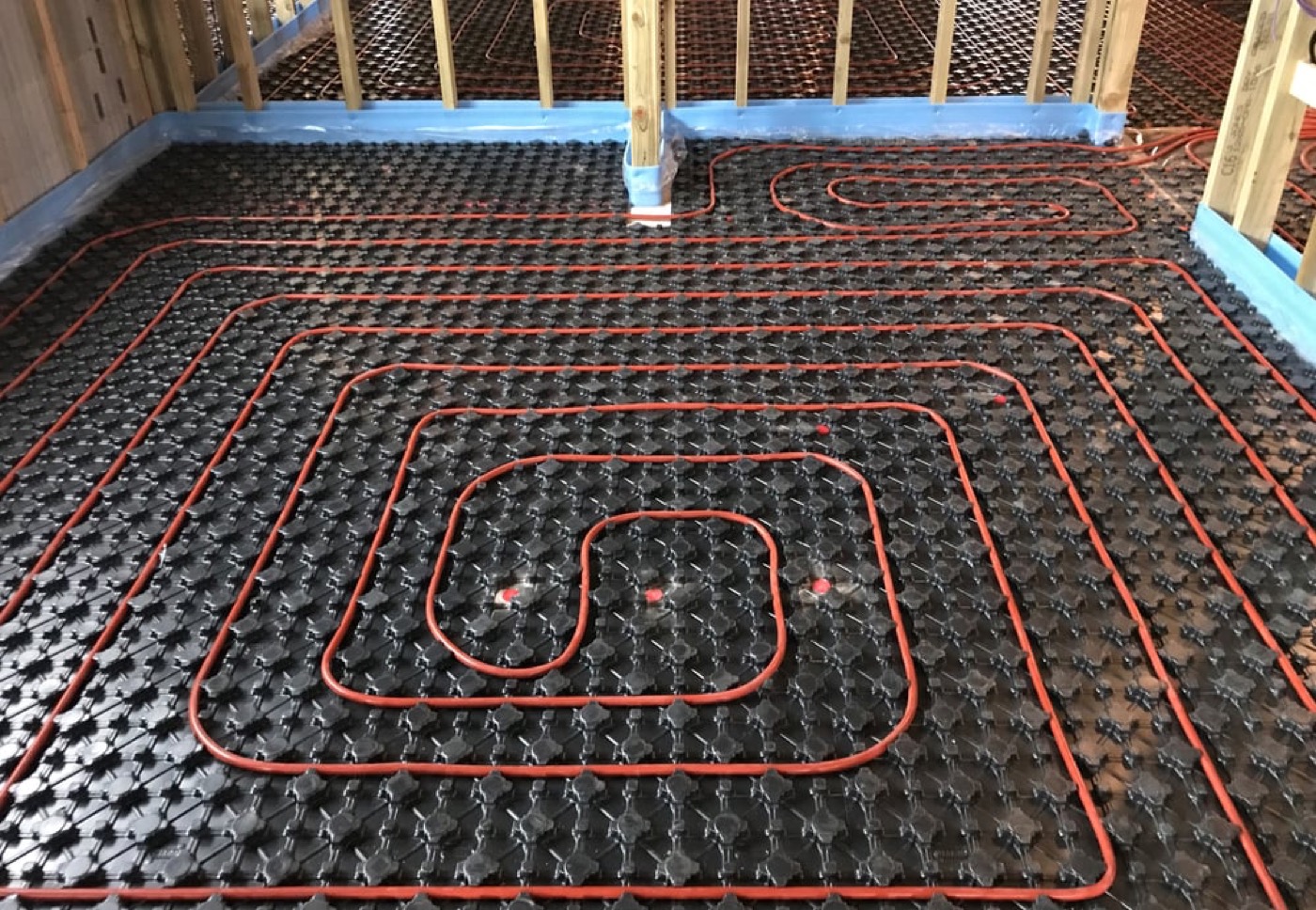
If the manifold is dry, the vessel is sound and the pressure still falls steadily, a loop may be leaking under the floor. Signs include a damp or warm patch on the surface, a stain on a ceiling below, or a floor that stays cool in one patch while the flow meter for that loop reads normally. The usual next step is to close the loops one at a time at the manifold and see which one holds pressure when isolated. That narrows the problem to a single circuit before anyone thinks about opening a floor.
What happens next depends on how the floor is built: pipes in screed, pipes in a timber floor with spreader plates, or a thin overlay system. A single joint can often be repaired without replacing a whole loop. For the wider picture of what is installed under the floor, see our underfloor heating guide.
What Not to Do
- Do not keep topping up for months. Each top-up brings in fresh water with oxygen, which corrodes steel and speeds up sludge. Our piece on repressurising a system yourself or calling an engineer explains where to stop.
- Do not pour in leak sealer. Underfloor loops are narrow and the manifold has small passages and flow meters.
- Do not lift a floor on a guess. The cause is far more often at the manifold.
- Do not open a boiler casing. If you smell gas at any point, turn the supply off at the meter if it is safe to do so and call the National Gas Emergency Service on 0800 111 999.
Clean system water makes everything above easier. Debris keeps vents and valves from seating, and it blocks the narrow loops. A magnetic filter catches much of it, and our magnetic filter installation service covers fitting one. If your system is open-vented rather than sealed, the pressure behaves differently; see sealed or open-vented heating systems to check which you have.
When to Call Us
Call if the gauge is falling day after day, if you find water or crust at the manifold, if the relief pipe is dripping, or if you have already topped up more than once. Our engineers work through the system in order: the readings, the vessel, the filling loop, the manifold and its vents, then loop-by-loop isolation if water is still going missing. We will tell you what we find and what a repair involves before any work starts. If you would like a visit, get in touch. For new or reworked floors, see our underfloor heating installation service.
Frequently asked questions
Is it normal for underfloor heating pressure to drop?
A small fall is normal in the first weeks after filling, or after a loop has been drained, because air comes out of the water and is vented. A fall that continues day after day, or needs repeated top-ups, is not normal and points to a leak or a faulty expansion vessel.
Why does my underfloor heating pressure drop when the heating is off?
The water cools and contracts, so the gauge naturally reads lower when the system is cold. Compare cold readings from day to day. If the cold reading keeps falling, water is being lost, usually at the manifold, an air vent or through the relief valve.
Can I top up the pressure on underfloor heating myself?
Yes, on a sealed system, using the filling loop to the pressure given in your manual, and closing it afterwards. If you have to do it more than once, find the cause rather than keeping on. Topping up repeatedly brings in oxygen that corrodes the system.
Does a leak under the floor always mean lifting the floor?
Not always. Most leaks are at the manifold and can be repaired in the cupboard. If a buried loop is leaking, engineers isolate loops one at a time to find which circuit it is, and a single joint can often be repaired without replacing the whole loop.
Should I use leak sealer in an underfloor heating system?
We would not. The loops are narrow, and the manifold's small passages and flow meters can collect the particles that sealers rely on. Finding and fixing the actual fault is the safer route.